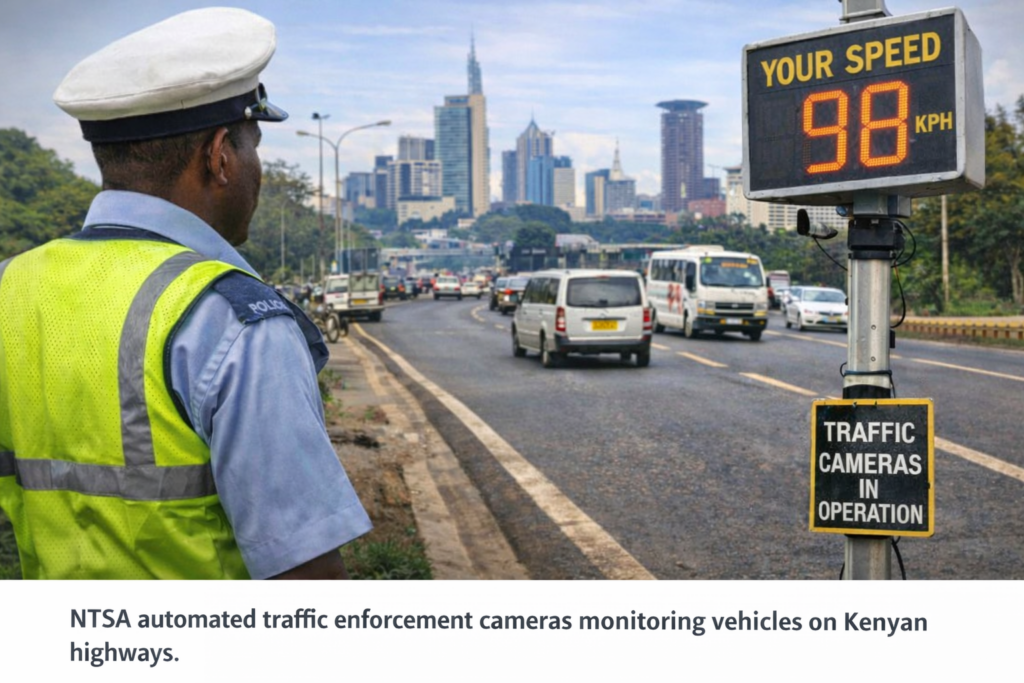
It’s a typical weekday evening in Nairobi. Traffic is slowly building along Uhuru Highway as commuters rush home. A matatu ahead of you is weaving between lanes, boda bodas are squeezing through the smallest gaps imaginable, and the radio is busy discussing the latest fuel prices.
Suddenly your phone vibrates. You glance at the screen expecting a WhatsApp message. Instead, you see this:
“NTSA NOTICE: Traffic violation detected. Fine: KES 3,000. Pay within 7 days.”
For a moment you wonder if it’s a scam. It isn’t. Welcome to the new reality of NTSA instant fines in Kenya. Across the country, the National Transport and Safety Authority has begun deploying an automated traffic enforcement system designed to catch violations using cameras and digital monitoring tools.
The days when traffic offences were only detected during roadside stops are slowly fading. Today, the officer who catches you speeding may not be standing beside the road.
The Rise of the Instant Traffic Fine
The most significant development is the NTSA Instant Fines Traffic Management System, which is now being rolled out across major Kenyan roads. The system relies on a network of over 1,000 traffic cameras, including both fixed and mobile units, strategically placed along highways, urban roads, and high-risk accident zones.
These cameras monitor violations such as:
- Speeding
- Illegal parking
- Ignoring traffic lights
- Driving on pedestrian walkways
- Seatbelt violations
- Use of mobile phones while driving
Once a violation is detected, the system automatically generates a fine and sends the driver an SMS notification detailing the offence and payment instructions.
There is no argument with a camera. And unlike traditional enforcement, the system does not rely on an officer physically stopping your vehicle.
Seven Days to Pay or Face Consequences!!!
Once a driver receives the notification, the clock begins to tick. Under the new system, motorists have seven days to pay the fine using designated payment channels such as bank platforms, mobile money, or NTSA’s digital services.
Failing to pay within this period triggers automatic penalties. The unpaid fine begins to accumulate interest, and more importantly, the driver’s records are flagged in the NTSA database. Once this happens, several services become inaccessible.
For example, you may not be able to:
- Renew your driving licence
- Transfer vehicle ownership
- Register a new vehicle
- Access NTSA online services
In short, a simple traffic offence could quietly follow you until it disrupts an entirely unrelated transaction months later.
The Most Common Traffic Fines Drivers Are Facing
While the system captures dozens of minor offences, some violations remain particularly common on Kenyan roads. Below is a simplified breakdown of typical fines motorists may encounter.
| Offence | Fine |
| Speeding 6–10 km/h above limit | KES 500 |
| Speeding 11–15 km/h above limit | KES 3,000 |
| Speeding 16–20 km/h above limit | KES 10,000 |
| Driving without number plates | KES 10,000 |
| Driving without a valid driving licence | KES 1,000 |
| Using a mobile phone while driving | KES 2,000 |
| Failure to wear a seatbelt | KES 500 |
| Driving on a pedestrian footpath | KES 5,000 |
| Causing road obstruction or illegal parking | KES 10,000 |
| Failure to carry lifesaver triangles | KES 2,000 |
At first glance, some fines appear small. But the cumulative effect can be significant, particularly for drivers who repeatedly violate road rules.
Matatus, Buses and Commercial Vehicles Under Even Tighter Scrutiny
Public Service Vehicles (PSVs) are among the biggest targets of the new enforcement system. The digital network automatically links violations committed by a PSV to the registered owner of the vehicle, meaning operators cannot easily escape responsibility by blaming drivers.
Common PSV-related offences include:
- Operating without a qualified driver or conductor
- Conductors failing to wear official identification badges
- Unauthorized passenger pick-up or drop-off points
- Touting or soliciting passengers unlawfully
Fines for these offences can range from KES 2,000 to KES 10,000 depending on the breach. For matatu operators already navigating tight margins and strict regulations, compliance is no longer optional.
A New System of Driver Accountability
Another significant shift in enforcement is the introduction of demerit points attached to a driver’s record. Each violation contributes to a growing history of misconduct. Persistent offenders may face:
- Higher penalties
- Suspension of driving privileges
- Increased regulatory scrutiny
The aim is to discourage habitual offenders and encourage long-term compliance. In other words, the system does not just punish individual mistakes it builds a behavioral record.
Technology Versus Road Culture
For decades, Kenya’s road enforcement has largely depended on physical traffic stops. In that environment, enforcement could be inconsistent, and sometimes negotiable.
The new system attempts to remove that human element entirely. A camera does not negotiate. A database does not forget. And a digital notification arrives whether you are in Nairobi, Mombasa, or Eldoret. For many drivers, this represents a cultural shift in how traffic rules operate in practice.
Concerns from Transport Operators
While many road safety advocates welcome the move toward digital enforcement, transport sector stakeholders have raised several concerns. Public transport associations argue that drivers need clearer guidance about:
- Where traffic cameras are located
- Which offences are monitored automatically
- How disputes can be resolved if a fine is issued incorrectly
These concerns reflect the reality that the transition to automated enforcement is still relatively new, and many drivers are learning about the system only after receiving their first notification.
The Bigger Picture: Why NTSA Is Doing This
Kenya continues to face a serious road safety challenge. Every year, thousands of lives are lost in road accidents, many linked to speeding, reckless driving, and non-compliance with basic safety rules.
By introducing automated enforcement, authorities hope to:
- Reduce human error in enforcement
- Limit corruption associated with roadside policing
- Ensure traffic laws apply equally to all drivers
In theory, the system creates a level playing field. Whether you are driving a small hatchback, a boda boda, or a luxury SUV, the same rules apply.
What Sharp Drivers Should Do Now
The best defence against instant fines is simple awareness. Drivers should adopt a few practical habits:
- Respect posted speed limits at all times
- Avoid using mobile phones while driving
- Ensure all vehicle documentation is valid and accessible
- Carry mandatory safety equipment such as lifesavers
- Follow proper parking and pedestrian rules
Most importantly, motorists should take every SMS notification seriously and verify their status through official NTSA platforms. Ignoring the message will not make it disappear.
The Road Ahead
Kenya’s transition toward automated traffic enforcement signals a broader modernization of road governance. The days when traffic offences were handled solely at roadside stops may gradually disappear, replaced by a system where violations are detected, recorded, and penalized digitally.
For drivers, this means adapting to a new reality. Because on today’s roads, the officer who catches you speeding might not be standing beside the road. It might be mounted quietly on a pole above it.
Frequently Asked Questions About NTSA Fines in Kenya
How long do you have to pay an NTSA fine? Drivers must pay the fine within 7 days of receiving the notification.
What happens if you ignore an NTSA fine? Unpaid fines may attract penalties and can block access to NTSA services such as vehicle transfer or licence renewal.
Can NTSA cameras detect speeding automatically? Yes. The new system uses automated speed cameras and digital monitoring technology installed on major roads.
How much is the fine for using a phone while driving in Kenya? The fine for using a mobile phone while driving is KES 2,000 under the minor offences schedule.